Showing posts with label Book Club. Show all posts

Thursday, March 28, 2013

Literary Bite: The Swan Thieves by Elizabeth Kostova


I suggested my book club read The Swan Thieves by Elizabeth Kostova, but honestly, I have no idea who recommended it to me in the first place. Anyone? [Update: mystery solved, it was this lovely grammarian.] Oh well, I’m glad it was good!

It's about an incredibly talent American painter, Robert Oliver, who attacks a painting at the National Gallery (I love stories that take place in DC!). After that Oliver refuses to speak, so his psychiatrist, Marlow, takes an unconventional approach to Oliver’s treatment and digs into Oliver’s past. “As Marlow is pulled deeper within Oliver’s troubled mind, he uncovers a tale of love, betrayal, and artistic obsession, and finds surprising possibilities in a package of nineteenth-century love letters.” (source)

Basically it is Marlow going back through the women in Oliver’s life – his ex-wife, mistress, and a mysterious and captivating woman in a painting – trying to piece it all together, but then getting sucked in to Oliver’s obsessions himself.

Don’t be intimidated by the book's length, just settle in for the ride. The story switches narrators and time periods chapter by chapter, so it really never drags. I preferred the modern-day parts of the story over the nineteenth century pieces, but they all came together well. The Swan Thieves isn’t particularly revolutionary, just a very nice read.

Oddly enough, as a non-artist, I really enjoyed reading about painters painting:

  • “The wilted garden is already covered with subtle color - indeed, it isn’t white. Beige, today? Silver? Colorless, if there is such a thing?”
  • “I believe in walking out of a museum before the paintings you've seen begin to run together. How else can you carry anything away with you in your mind's eye?”
  • “I don't think painters have the answers about a painting except the painting itself. Anyway, a painting has to have some kind of mystery to it to make it work.” 

The painting that Oliver attacks in the book is pure fiction -- “Leda” by Gilbert Thomas does not exist, nor does an artist named Gilbert Thomas for that matter. The swan myth it's based on is real though, and there are a lot of paintings depicting that story (Zeus comes to earth in the form of a swan and either rapes or seduces the beautiful Leda). The closest painting at the National Gallery is Raphael's Leda and the Swan, c. 1507:


Conclusion? A lovely read. I say go for it!


Thursday, June 14, 2012

Literary Bite: State of Wonder by Ann Patchett

I’m sorry to report that while State of Wonder is a good book, it’s probably my least favorite of Ann Patchett’s novels. Her others – Bel Canto, Run, An Equal Music – are just so awesome that this latest addition to her authorship pales in comparison. But to be fair, like all her books State of Wonder is well-written, creative (subject-wise), and  I did like it.

In State of Wonder, Patchett returned to her Bel Canto roots, creating a situation of a group of strangers shipwrecked in a South American jungle.

The protagonist is Marina Singh, a Minnesotan pharmacist working for a company that is trying to developing a fertility drug in the Brazilian Amazon. Marina travels to the jungle to find Dr. Annick Swenson (the evil(ish) genius heading up this research) and follow up on the death of her friend and co-worker, Anders, who had died on a similar reconnaissance mission a few months before.

The stakes are high in the jungle, both fiscally (if the drug worked it would make major dollars) and physically (upon arrival, Dr. Swenson warns Marina in no uncertain terms that she will not inconvenience herself to save pesky researchers).
 “She found a village of people in the Amazon, a tribe,” Anders had told Marina, “where the women go on bearing children until the end of their lives. . . . Their eggs aren’t aging, do you get that? The rest of the body goes along its path to destruction while the reproductive system stays daisy fresh. This is the end of I.V.F. No more expense, no more shots that don’t end up working, no more donor eggs and surrogates. This is ovum in perpetuity, menstruation everlasting. . . . Pretend for a moment that you are a clinical pharmacologist working for a major drug development firm. Imagine someone offering you the equivalent of ‘Lost Horizon’ for American ovaries.”
Patchett has a genius for complex character development. Dr. Swenson is a detestable as Marina is likeable, though as the book goes on layers and layers are added to the despot-like doctor’s character, humanizing her and making you care.

I guess my only major criticism is that State of Wonder starts kind of slow…but much like Night Circus, by the time I got to the last hundred or so pages (it’s a 350-page book), I could not put it down. I won’t spoil the ending for you, but there are totally amazing and unexpected twists!!!

I admit to being a very critical critic (only the best!), so if you want a second opinion, the NYT gave it a good review, as did NPR.

Thursday, May 31, 2012

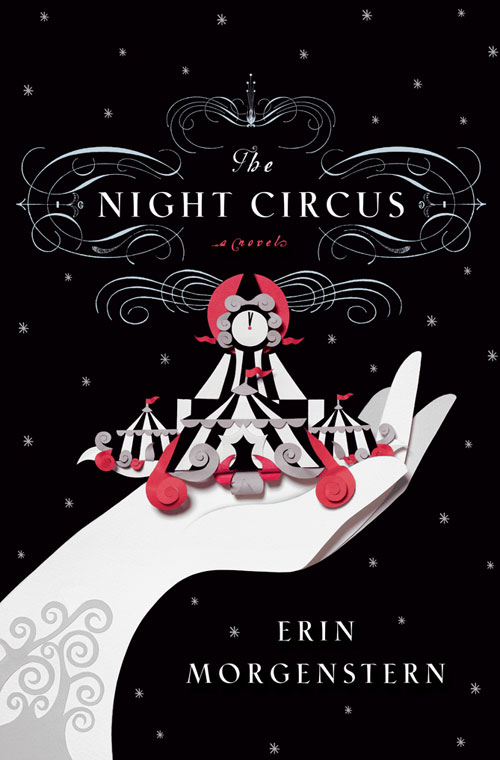
Literary Bite: Night Circus

It took a while for me to get into Night Circus, but then I accidentally Metro'ed all the way to Silver Spring last weekend because I was so into the story I missed my stop! Which means a) the book is good, b) I am a space cadet, or c) both a and b.

The story is about magic, but it’s not fantasy, and it’s realistic(ish), but it’s not magical realism. Night Circus by Erin Morgenstern is exactly the kind of book that I usually like. It’s centered around The Cirque des Rêves (literally “Dream Circus”) that takes place at night and is famous for wild magical acts and laws-of-nature-defying tents. I think Morgenstern did a great job of grounding her fantasy in fact. The book was just magical enough to be fun and fascinating with a minor suspension of disbelief, but not soooo much that it lost me (as happens when I read magical realism - Rushdie I'm looking at you).

The main characters are Marco and Celia, two young magicians who have been groomed to participate in some grand challenge of magic that neither of them or anyone around them really understands.

This is Morgensern’s first book and it is impressively complicated. The narrative jumps around in time (each chapter starts by noting the date) and perspective, but all comes together very well at the end. I found the non-linear format mildly annoying, in that for a lot of the book I wasn’t really sure when the action was happening and had to flip back to understand the order of events.

But the book got better and better as I read – for the last 200 pages (it’s 400 total) I couldn’t put it down!
Read a good review here.

My book club is discussing it tonight, so here are some things for us to think about:

Night Circus Discussion Questions

  • The novel opens with a quote from Oscar Wilde: A dreamer is one who can only find his way by moonlight, and his punishment is that he sees the dawn before the rest of the world. How is this sentiment explored in The Night Circus? Who in the novel is a dreamer? And what is their punishment for being so?
  • Why are Frederick Thiessen and the reveurs important to the story? Why do you think some people were so entranced by the circus that they devoted themselves to following it around?
  • The novel frequently changes narrative perspective. How does this transition shape your reading of the novel and your connection to the characters and the circus? Why do you think the author chose to tell the story from varied perspectives?
  • Did you feel sorry for those who were being used in the game -- Isobel, the Burgess sisters, even Celia and Marco? Why do you think some people, like Mr. Barris, don't mind being trapped by the circus while it drives others, like Tara Burgess, mad?
  • What role does time play in the novel? From Friedrick Thiessen’s clock, to the delayed aging of the circus developers, to the birth of the twins—is time manipulated or fated at the circus?
  • What did you think of Bailey? Why do you think Bailey was willing to give his life to the circus?
  • How does the following statement apply to both Le Cirque des Rêves and the competition? Which audience is more valuable: one that is complicit or one that is unknowing?
  • Chandresh relishes reactions. Genuine reactions, not mere polite applause. He often values the reactions over the show itself. A show without an audience is nothing, after all. In the response of the audience, that is where the power of performance lives.
  • Mr. Barris, Friedrick Thiessen, Mme. Padva, and even Bailey are aware that the circus has made a profound, inexplicable, change in their lives, but they each choose not to explore the depth of these changes. Friedrick Thiessen confirms that, “I prefer to remain unenlightened, to better appreciate the dark.” Do you agree with this standpoint? What inherent dangers accompany a purposeful ignorance? What dangers present themselves when ignorance is not chosen? Is one choice better/safer than the other or are they equally fraught?
  • Why does the man in the grey suit feel so passionate about stories? What sort of commentary do you think the chapter "Stories" is on the novel? On life?
  • The book takes place at the turn of the 20th century. Why does Bailey’s business card provide an email address?
Have you read Night Circus? What did you think? 


Wednesday, April 25, 2012

Literary Bite: Rules of Civility

Rules of Civility by Amor Towles was like reading a really good romantic comedy (and I mean that in the best way possible).

The setting (New York, 1938s) and the characters (25-year-old women trying to figure out work and life) were similar enough to me to forge a connection, but different enough to amuse rather than annoy.

The entire book is kind of like a daydream – what if my life involved accidentally running into multimillionaires and going on fabulous dates to the fanciest places? (Yes, I realize that in that case my life would be fiction. But it’s still fun to read about!) However, though it appears to be all good and wonderful in the lives of the main characters, best friends Katey and Eve, one of the major themes of the book is that appearances aren’t always what they seem.

The story takes place over the course of one year (as stories that start on New Year’s Eve almost inevitably do). The author also wrote it in a year, starting January 1, 2006, and finishing 365 days later. Interestingly enough, “The book was designed with 26 chapters, because there are 52 weeks in the year and I allotted myself two weeks to draft, revise and bank each chapter.”

And I was surprised to realize half-way through reading that Towles is a man! In an interview he said, “I prefer to put myself in an environment that’s farther afield and look through the eyes of someone who differs from me in age, ethnicity, gender and/or social class. I think a little displacement makes me a sharper observer.”

This review likens it to Sex and the City and Breakfast at Tiffany’s, which is semi-accurate, but I felt the novel had more depth that those parallels suggest. "One night at the novel’s outset touches off the chain reaction that will produce both Katey’s career and her husband, and define her entire adult life," (NYT) but at the time she doesn't realize it. The characters themselves feel real and are generally likeable (or detestable when appropriate). And as a detailed period piece it really transports you to (at least my imagination's version) of New York in the late 1930s.

Rules of Civility is a fast-reading amusing book. I recommend it!

Thursday, December 1, 2011

Literary Bite: All the King's Men


I can't say that I loved All the King's Men by Robert Penn Warren, but I can see why it's considered an American political classic. The 1946 NYT review said, "Warren's "All the King's Men" is magnificently vital reading, a book so charged with dramatic tension it almost crackles with blue sparks, a book so drenched with fierce emotion, narrative pace and poetic imagery that its stature as a "readin' book," as some of its characters would call it, dwarfs that of most current publications."  


I do agree with that part...the part I can't get on board with is the statement, "Here, my lords and ladies, is no book to curl up with in a hammock, but a book to read until 3 o'clock in the morning, a book to read on trains and subways, while waiting for street cars and appointments, while riding elevators or elephants."


My problem with this book is that I had a hard time getting into it. I found myself daydreaming while reading All The King's Men...part of this could be that I've been distracted with many things recently...but part could be that there are boring segments that are totally skimmable.But I kept reading to though the end for two reasons: 1) it's a book club assignment and as a matter of pride I finish all book club books, and 2) The parts that were good were really good. Especially towards the end.


All the King's Men is the story of the rise and fall Willie Stark, of a political titan in the Deep South during the 1930s. "The Boss" rises from poverty to become a corrupt politician and presents the classic questions, does power always corrupt? And do good intentions justify questionable means? The book is about Willie Stark, but really it's the story of Jack Burden, Willie's right-hand man. Jack uses his historian skills to dig up dirt on the boss's enemies, but in the course of doing so uncovers uncomfortable secrets about his own life. At its core, the novel is much more philosophical than political.


I'm glad I read All the King's Men - it ended well, and as I said, I got into the story by the end. So this isn't an un-recommendation, just not a shining endorsement. Proceed at your own risk. 

Thursday, October 20, 2011

Literary Bite: The Three Musketeers


The Three Musketeers is the ultimate adventure/action book. It’s totally over-the-top -- gallantry and chivalry and duels and honor and all that, but in a really fun way. The book was originally written in serial form, much like Charles Dickens’ books. But unlike Dickens, Dumas writes all-action (no philosophizing). Every chapter ends with a cliff-hanger that makes you want to keep reading. 

The story is about four comrades in arms – Athos, Porthos, Aramis, and D’Artagnan (yes, that “Three” in the title is misleading). They are men of honor serving King Louis XIII of France in the King’s guards, aka the musketeers. The intrigues they get mixed up in involve all levels of royalty and require dashing deeds of bravery (or stupidity, if you want to look at it too seriously). One great adventure mid-book is their ride across the country to France. All four set off with their lackeys on a desperate mission to retrieve two diamond studs from Lord Buckingham for the Queen of France. It’s a pretty awesome story-line…I won’t give anything away. 

There’s also a bit of romance – every knight must have his lady to honor, right? They fall in love with women (D’Artagnan especially), and fight a ridiculous number of duels. “Fight duels on all occasions, the more so because duels are forbidden and consequently it takes twice as much courage to fight them.”

I think it’s interesting that the most evil character is a woman – Milady is one of the smartest characters and is also pure evil.  “It was easy to conquer, as she so often had, men who were used to the gallantries and intrigues of life at court and who were quick to let themselves be seduced. She was beautiful enough not to find much resistance on the part of the flesh, and clever enough to prevail over any obstacles of the mind.”

Athos' thoughts on that: “I do not trust women, particularly fair women. Can it be otherwise? I bought my experience dearly.”

The writing is a little dated, but very clever. Dumas is funny and his characters are kind of sassy. 

“You are very amiable, no doubt, but you would be charming if you would only depart.” 

You’ll like The Three Musketeers if you liked The Count of Monet Cristo, or Les Misérables.

And conveniently I read it just before a new movie comes out! 

(Hmm, just watched the trailer...looks even more over-the-top ridiculous than the book is...)

Thursday, September 22, 2011

Literary Bite: Freedom


In an uncharacteristic venture into the modern, my bookclub recently opted to read the 2010 it-book, Freedom by Jonathan Franzen.

I never read Franzen’s breakout book, The Corrections, because my mama didn’t like it and I trust her judgment in everything. Freedom, however, is called a stand-alone “masterpiece of American fiction” and I totally agree.

At our discussion (for which I provided Lemon Bars as brain-fuel), we mused over the question – does Freedom really define our generation/the current age? Is this book to the early 2000’s as Tender Is the Night is to the 1920s?

I think my friends and I have a pretty good perspective on this. To a degree, we are the characters of the story – middle-class white Americans. Our parents are the same ages as Patty and Walter, and we’re the same ages as Joey and Jessica.

Franzen’s strength lies in his ability to succinctly describe inter-personal relationships. And since there are so many relationships in the book (husband-wife, child-parent, sibling-sibling, spouse-lover, friend-friend, etc.), it’s hard not to see yourself reflected in their actions and emotions.

This narrative takes things to the extreme – I like to think that not everyone struggles with depression and alcoholism as much as Franzen’s characters…but maybe they do? It’s hard to give a good summary, the story is really complex. But basically, it’s told from the perspective of Patty, and former All-American basketball player who marries the “safe” guy (Walter) and has a family.

The individual struggles and personal relationships are timeless, but the context is spot-on. The book starts in the late-1980s/early 90s, with back-story going back to the 1970s when Patty was growing up. The time-period themes are interesting and relevant – feminism/anti-feminism, gentrification, suburbanization, environmentalism, and the politics of the Clinton and Bush administrations.  

The title has layered meanings. Freedom as a theme is central to Freedom the book. Individuals strive for personal freedom (i.e. Joey from Patty), while the story is set in a time where then entire society is re-defining what freedom means (post-9/11 America).

The book is underhandedly political. I would say liberal, but sometimes it’s hard to tell if Franzen actually believes in American liberalism, or if all 576 pages are a critique of it. The NYT review put it well:
Franzen grasps that the central paradox of modern American liberalism inheres not in its doctrines but in the unstated presumptions that govern its daily habits. Liberals, no less than conservatives — and for that matter revolutionaries and reactionaries; in other words, all of us — believe some modes of existence are superior to others. But only the liberal, committed to a vision of harmonious communal pluralism, is unsettled by this truth.
This book is definitely worth the read. It’s long, but I couldn’t put it down!


Thursday, July 21, 2011

Literary Bite: Tender is the Night


Tender is the Night is my favorite book club book to date. It’s romance and drama and tragedy all combined and told in the most beautiful and sometimes heartbreaking way. (Plus more GRE words than We Need to Talk About Kevin…oof!).  

F. Scott Fitzgerald is far more famous for The Great Gatsby (which I haven’t read…I know, I know). Tender is the Night was published in 1934 and was a commercial failure, but I thought it was great!

"This disturbing tale of the turbulent relationship of wealthy expatriate couple Dick and Nicole Diver and their blithe existence on the French Riviera illustrates, among many things, images of Americans abroad, corruption by money, mental disintegration, atavistic attraction to charm and sexual jealousy, and loss of the father." (source)

So basically that’s everything 1920s and Freudian all at once.

From a brief googling venture, I suspect that Tender is the Night is at least semi-autobiographical. Much like his character Dick Divers, Fitzgerald was married to a woman suffering from mental illness and lived in Europe for years. Plus, both men served in WWI, but neither saw the front lines. In the novel, Dick cheated on his wife with a Hollywood starlet (Rosemary), while in real life Fitzgerald left his for a Hollywood columnist. Both men were alcoholics.

The prose, like I said, is gorgeous. Fitzgerald fits a lot into the 300 pages, and I especially admire his ability to really capture something (an emotion, a moment, a person) in the exactly right words.

Romance:
"You're the only girl I've seen for a very long time that actually did look like something blooming."
- F. Scott Fitzgerald, Tender is the Night, Book 1, Ch. 4

Description:
"the moment when the guests had been daringly lifted above conviviality into the rarer atmosphere of sentiment, was over before it could be irreverently breathed, before they had half realized it was there."
- F. Scott Fitzgerald, Tender is the Night, Book 1, Ch. 7

Drama/Tragedy:
"She illustrated very simple principles, containing in herself her own doom, but illustrated them so accurately that there was grace in the procedure, and presently Rosemary would try to imitate it."
- F. Scott Fitzgerald, Tender is the Night, Book 1, Ch. 12

Clearly I have nothing on Fitzgerald, so you should probably just read the book and get back to me on what you think!

This site has some really good discussion questions.

And a bonus Fun Fact: The title comes from Keats’ poem, "Ode to a Nightengale."

Thursday, June 16, 2011

Literary Bite: Crime and Punishment

If you have a challenge-loving book club like mine, you may want to consider reading Fyodor Dostoyevsky’s Crime and Punishment. It’s one of those impressive books to have read, and really isn’t as punishing as it sounds. At about 600 pages (depending on your translation) it’s long, but the story miraculously sucks you in and moves along, despite the fact that nothing really happens.


I’m presenting Crime and Punishment at my book club meeting this weekend, so here’s my discussion guide for your enjoyment…

"Can evil means justify honorable ends?"

Crime and Punishment is Dostoyevsky’s second full-length novel, and the first thing he published after his time in a Siberian prison camp (his name is pronounced dahs-tuh-YEF-skee). It was originally supposed to be about drunkenness (titled The Drunkards), but Dostoyevsky decided to focus instead on a murderer's first-person confession, making his original theme ancillary*.

It was originally published over the course of a year in 1886 as a series in The Russian Messenger.
About Dostoyevsky:

Dostoyevsky grew up in a middle-class family in Moscow. His father, a doctor, was a tyrant toward his family, and his mother was a mild, pious woman who died before Dostoyevsky was sixteen. At his father's insistence, Dostoyevsky trained as an engineer in St. Petersburg. While the youth was at school, his father was murdered by his own serfs at the family's small country estate. Dostoyevsky rarely mentioned his father's murder, but Oedipal themes are recurrent in his work, and Sigmund Freud suggested that the novelist's epilepsy was a manifestation of guilt over his repressed wish for his father's death.

Dostoyevsky graduated from engineering school but chose a literary career. In 1848 Dostoyevsky joined a group of young intellectuals, led by Mikhail Petrashevsky, which met to discuss literary and political issues. In the reactionary political climate of mid-nineteenth-century Russia, such groups were illegal, and in 1849 the members of the so-called Petrashevsky Circle were arrested and charged with subversion. Dostoyevsky and several of his associates were imprisoned and sentenced to death. As they were facing the firing squad, an imperial messenger arrived with the announcement that the Czar had commuted the death sentences to hard labor in Siberia for ten years. This scene was to haunt the novelist the rest of his life. His intense study of the New Testament, the only book the prisoners were allowed to read, contributed to his rejection of his earlier liberal political views and led him to the conviction that redemption is possible only through suffering and faith, a belief which informed his later work.

Crime and Punishment is the novel in which Dostoyevsky first develops the theme of redemption through suffering.
Russian names are notoriously tricky, everyone has at least two, and they are used interchangeable, often making Russian literature difficult to follow (remember Anna K.? And The Master and Margarita? That book nearly killed LLC.)


Name Word Meaning (in Russian)
  • Rodion Romanovich Raskolnikov - raskol - a schism, or split; "raskolnik" is "one who splits" or "dissenter"; the verb raskalyvat' means "to cleave", "to chop","to crack","to split" or "to break"
  • Pyotr Petrovich Luzhin - luzha - a puddle
  • Dmitri Prokofich Razumikhin - razum - rationality, mind, intelligence
  • Alexander Grigorievich Zamyotov - zametit - to notice, to realize
  • Andrey Semyenovich Lebezyatnikov - lebezit - to fawn on somebody, to cringe
  • Semyon Zakharovich Marmeladov - marmelad - marmalade/jam
  • Arkady Ivanovich Svidrigailov - Svidrigailo - a Lithuanian duke of the fifteenth century
  • Porfiry Petrovich - Porphyry - (perhaps) named after the Neoplatonic philosopher
Discussion Questions:
  1. For more than a century, critics have argued about the book's message: Is it a political novel? A tale of morality? A psychological study? A religious epic?
  2. The crime itself is only given a few pages, and the actual punishment isn’t addressed until the epilogue…so what is the novel about?
  3. Who is the real criminal? Marmeladov, for abandoning his family? Luzhin for exploiting Dunya? Svidrigailov for murdering his wife? Sonya for prostituting herself? The greedy pawnbroker whom Roskolnikov murdered?
  4. Who among us is not a criminal? Who among us has not attempted to impose his or her will on the natural order?
  5. The novel was originally written in first person, why do you think Dostoyevsky decided to change it into third? How did the POV affect the telling of the story?
  6. Sonya and Raskolnikov have one thing in common – they share the same feelings of shame and alienation. Compare and contrast their circumstances that lead them to this shared feeling. How does this bring them together? Why does Raskolnikov confess to her?
  7. Raskolnikov wavers between wanting to confess his crime, and desperately hoping to get away with it. Why?
  8. Raskolnikov has a theory that some people have a right to commit crimes, and are somehow above the law. He argues that with the pawnbroker's money he can perform good deeds to counterbalance the crime, while ridding the world of a worthless parasite. He also commits this murder test his own hypothesis that some people are naturally capable of, and even have the right to, do such things. Can you think of any modern-day examples of this attitude?
  9. Discuss Roskolnikov's theory of the ordinary versus the extraordinary man.
  10. Compare the characters of Roskolnikov, Luzhin, and Svidrigailov. How is each of these men a "villain," and to what extent are they guilty? How does each man face his guilt, and how does each suffer for it?
  11. Compare the major female characters: Sonya, Dunya, Katerina Ivanovna. Do you think they are well-rounded characters or stereotypes? How does each figure in Roskolnikov's actions?
  12. Later, in confessing the murder to Sonya, Roskolnikov claims, "Did I really kill the old woman? No, it was myself I killed.... And as for the old woman, it was the Devil who killed her, not I." (p. 488) What does he mean by this? Why doesn't the confession ease him of his inner torment?
  13. Does the fact that Roskolnikov never uses the money he stole from the pawnbroker make him less-or more-guilty? Why do you think he never recovers the stolen items or cash?

*Ancillary - ajd. auxiliary; assisting.


Thursday, April 14, 2011

Literary Bite: What We Talk About When We Talk About Love


What We Talk About When We Talk About Love is a collection of short stories by Raymond Carver, America's short story master. 


His writing style is very sparse and minimalist. Some of the stories are only a couple pages long, and none take more than ten minutes to read. Just as you’re settling in, the story stops at an unsatisfying non-ending. It can be jarring to re-orient to a new narrator every few pages, but that’s part of the power of Carver’s fiction – it keeps you on your toes.

As the title suggests, the collection is about love and human relationships, but not in the way you would expect. The book as a whole is perplexing and often depressing. According to English professor Fred Moramarco, it’s about Carver’s “puzzlement about the odd and battered condition of love in the contemporary world.”

Many of the stories are disturbing. Carver touches on all kinds of love - spiritual, carnal, platonic, possessive, brutal, obsessive, unrequited, and even parental, searching for what "real" love is. And since his stories end so abruptly, you’re always left wondering what really happened or what is going to happen.

Carver’s own love life was a bit strange, perhaps contributing to his slightly depressing perspective on love. When he was 18 he married a sixteen-year-old, Maryann Burk, and they had two kids right away. They separated twenty years later in 1976 and Carver was hospitalized for his alcoholism four times between 1976 and 1977 (they eventually divorced in 1983). He quit drinking in 1977, and published What We Talk About When We Talk About Love in 1981.

Because Carver wrote as a recovering alcoholic, alcohol often plays an important role in many of his stories. A common theme is two couples, spending time together and drinking, and usually misscommunicating. Drinking is often contrasted with eating – Carver presents food as nourishing and nurturing, while alcohol is a kind of empty substitute that serves to distort and confuse. (For more analysis, read Moramarco's whole essay here.)

Overall, I think What We Talk About When We Talk About Love is worth reading as an example of great American fiction. And it’s short – you’ll finish it in less than a week!


The Stories in the Collection:
  • Why Don't You Dance?
  • Viewfinder
  • Mr. Coffee and Mr. Fixit
  • Gazebo
  • I Could See the Smallest Things
  • Sacks
  • The Bath
  • Tell the Women We're Going
  • After the Denim
  • So Much Water So Close to Home
  • The Third Thing That Killed My Father
  • A Serious Talk
  • The Calm
  • Popular Mechanics
  • Everything Stuck to Him
  • What We Talk About When We Talk About Love
  • One More Thing


Thursday, March 24, 2011

Literary Bite: Heart of Darkness

I read Heart of Darkness for my book club, and alas, I was not a fan. I had such high expectations! It takes place in Africa. I love Africa! But unfortunately, for Heart of Darkness-loving reasons, I like paragraphs. I use them liberally. Joseph Conrad does not. This book is a series of stream-of-consciousness paragraphs that go on for pages!

To be fair, Heart of Darkness is not all bad. It’s a classic for a reason, and it’s definitely a book meant to be studied. According to Wikipedia (sorry, yes, I just went there), “Heart of Darkness exposes the dark side of European colonization while exploring the three levels of darkness that the protagonist, Marlow, encounters: the darkness of the Congo wilderness, the darkness of the Europeans' cruel treatment of the natives, and the unfathomable darkness within every human being for committing heinous acts of evil.”

The story is in the voice of a sea captain, Marlow, who sails up the Congo River working for a Belgian trading company in the notoriously brutal King Leopold’s Congo. As he travels into the depths of the jungle, Marlow becomes obsessed with the elusive Mr. Kurtz. Kurtz embodies the darkness lurking in individuals. He sees himself (and Europeans in general) as bringing light and civilization to Africa, but as he (and Marlow) travel deeper into Africa they abandon their own civility and become increasingly brutal. I think the Europeans are the ones bringing the “darkness.”

[Sidenote/fun-fact: when the Congo was granted independence in 1970 it had the highest literacy rate in Africa! Who would have thought?]

Chinua Achebe, one of the most famous African authors, argued that Heart of Darkness “de-humanized Africans, denied them language and culture and reduced them to a metaphorical extension of the dark and dangerous jungle into which the Europeans venture.” 

I totally agree, and assume that any modern reader would see the extreme racism in this book; however, it is important to consider Heart of Darkness in the context in which it was written. The book was published in 1901, at a time when racism was not an “issue” and colonialism was on the rise. Conrad traveled to the Congo in 1890 and his impressions of life there surely influenced his writing.

Like I said, I read Heart of Darkness for Book Club. But then I missed the discussion. Rumor has it there were very dark cupcakes...and a good presentation!

I won’t tell you not to read Heart of Darkness. It’s a widely read work of literature and is imitated in the movie Apocalypse Now (which takes place in Vietnam and Cambodia). All I’m saying is that if you have a thing for paragraphs like I do, Conrad might not be your author of choice. 

Thursday, February 10, 2011

Literary Bite: To the Lighthouse

Though I recognize that Virginia Wolf is one of the greatest modern writers, I did not particularly enjoy To the Lighthouse. We read it in my book club, and to be completely honest, if I wasn’t such as adamantly stubborn Book Club book finisher I probably would have quit about 30 pages in.

Luckily, the whole point of Book Club (for me at least) is to make me read and help me gain appreciation for books I wouldn’t normally read or like.

Through chatting with my fellow book-clubbers I learned that Virginia Wolf struggled with depression her entire life until she killed herself by filling her pockets with rocks and walking into a river (what a way to go!!!).

The plot of To the Lighthouse is set up like an “H”. The first part is one whole day of a family and friends at their summer home in the islands off of Scotland. Virginia Wolf is an absolute genius when it comes to exploring and capturing the essence of all types of human relationships - she articulates common emotions in the most amazingly accurate way.

And then ten years pass very quickly (the middle part of the “H”). WWII happens, the house decays, people die and Wolf just breezes over it (signifying the impermanence and irrelevance of life? Uhoh look at me getting deep).

And then the last part is another very detailed day. To the Lighthouse is one of those books where nothing really happens, because it’s more about human relationships.

So should you read it? Maybe. Some of my friends really liked it. And though I didn’t particularly enjoy reading it, I’m glad that I did.

And if you do read it, you should probably discuss it with friends (or your own Book Club) accompanied by lemon blueberry scones and shortbread (to go along with the book’s Scottish theme), and spinach artichoke dip (just because it’s delicious).

I’m pretty psyched about our next Book Club book: Heart of Darkness by Joseph Conrad.

Amazon tells us:
A masterpiece of twentieth-century writing, Heart of Darkness (1902) exposes the tenuous fabric that holds "civilization" together and the brutal horror at the center of European colonialism. Conrad's crowning achievement recounts Marlow's physical and psychological journey deep into the heart of the Belgian Congo in search of the mysterious trader Kurtz.

The Belgian Congo? I LOVE the Belgian Congo! (I know, I know, nerd alert!). So read it and we’ll discuss next month. 

Thursday, January 6, 2011

Literary Bite: Bleak House

My book club's theme is "Books We Haven't Read But Wish We Had Or Feel We Should." At our meeting to discuss Wonder Boys (which slightly strayed from the aforementioned theme), we talked about our next reading experience. 

How about some Charles Dickens? I suggested as we lounged on the floor of 6x6's apartment in a post-brownies sugar coma. My mama says that Bleak House is good, so do you want to do that for November? We all agreed that a trip to 18th century England was a good idea...until I went home and googled the book. Umm, guys, it's over 900 pages...maybe we should make this a 2-month-er?  A series of emails followed, joking about the impending "Bleak Christmas," the brick-esque nature of the book, the paid-by-the-word nature of Dickens' writing.

But I really enjoyed it! Charles Dickens is a literary genius, but you have to be patient. He spends almost the first half of the book on extensive descriptions of what seem to be random side characters. But don't get discouraged! As you continue, you realize that he was introducing necessary plot points, just in the most round-about way possible. His descriptions are amazing, he really captures all aspects of humanity in his pantheon of characters - from the sweet and generous Esther to the conniving Mr. Skimpole. (Another thing - great names!)

Some Dickens description examples:

"And there he sits, munching and gnawing, and looking up at the great cross on the summit of St. Paul's Cathedral, glittering above a red-and-violet-tinted cloud of smoke. From the boy's face one might suppose that sacred emblem to be, in his eyes, the crowning confusion of the great, confused city--so golden, so high up, so far out of his reach."


"The father of this pleasant grandfather, of the neighbourhood of Mount Pleasant, was a horny-skinned, two-legged, money-getting species of spider who spun webs to catch unwary flies and retired into holes until they were entrapped. The name of this old pagan's god was Compound Interest."

I'll be honest, I still don't have all the characters completely straight...but that didn't seem to really hurt my experience. And when the story picks up, it's intriguing and suspenseful - really a page-turner! I couldn't put it down for my entire flight back to CA after Sister1's wedding - that's about 7 hours of Dickens! (A caveat - not all my fellow book clubbers feel the same. LLC and LOTR-Emily claim that Dickens is the world's best cure for insomnia.)

Dickens presents some very interesting themes, all of which are as relevant today as they were when he wrote the book in 1853. The narrative centers around an arduous inheritance case, Jarndyce v. Jarndyce as a critique of the cumbersome legal system and example of fruitless obsession. Dickens analyzes human nature, mostly focusing on how some people take advantage of others (think Mr. Voles, Harold Skimpole, and Mr. Turveydrop). Other themes Dickens touches upon are extreme poverty (Jo), the ineffectiveness of charity (Mrs. Jellyby), and bad parenting (every character). The theme of bad parenting creating disillusioned children that perpetuate the abuse is very central to Bleak House. This theme can be extended to society as a whole, with bad "parents" (the legal system and government - aka Jarndyce v. Jarndyce) neglecting and abusing all the people of England.

"The Universe, I'm afraid, makes a rather poor parent."

This is not a book for the faint of heart, but if you consider yourself a Reader, then I think Dickens is an absolutely mandatory author to have in your arsenal.

To help you in your reading, here's a brief character guide. You can read a more detailed one here, but it will give away some major plot-points. (See what I mean? Lots of characters!)

Obviously, as the presenter and recommender of this book, I will be attending our impending book club meeting IN COSTUME. I'm thinking Jenny...

Bleak House Character List
Esther Summerson -  The narrator and protagonist. Esther, an orphan, becomes the housekeeper at Bleak House when she, Ada, and Richard are taken in by Mr. Jarndyce. Everyone loves Esther, who is selfless and nurturing, and she becomes the confidante of several young women. 
Mr. John Jarndyce -  Esther’s guardian and master of Bleak House. Mr. Jarndyce becomes the guardian of the orphans Ada and Richard and takes Esther in as a companion for Ada. Generous but uncomfortable with others’ gratitude, Mr. Jarndyce provides a warm, happy home for the three young people. Mr. Jarndyce has sworn off any involvement whatsoever with the Jarndyce and Jarndyce lawsuit.
Ada Clare -  A ward of Jarndyce. Kind, sweet, and naïve, Ada becomes Esther’s closest confidante and greatest source of happiness. She falls in love with Richard.
Richard Carstone -  A ward of Jarndyce. Affable but lazy, Richard can’t decide on a career and seems to have no passion for a particular field. Eventually, he becomes obsessed with Jarndyce and Jarndyce.
Lady Dedlock -  Mistress of Chesney Wold, married to Sir Leicester. Lady Dedlock, revered and wealthy, is seen as haughty and aloof. 
Sir Leicester Dedlock -  Master of Chesney Wold. Sir Leicester is a strong, respected man who is very formal but loves Lady Dedlock. 
Mr. Tulkinghorn -  A lawyer involved in the Jarndyce and Jarndyce lawsuit. 
Mrs. Baytham Badger -  A woman who talks incessantly about her former husbands.
Mr. Badger -  A doctor who agrees to take Richard on as an apprentice.
Mr. Matthew Bagnet -  A soldier who owns a musical instrument shop. Mr. Bagnet incurred debts to help George Rouncewell.
Mrs. Bagnet -  A woman who does all the talking for her husband.
Inspector Bucket -  A detective hired by Tulkinghorn to investigate Lady Dedlock’s past.  His wife helps him with his detective work.
Mr. Lawrence Boythorn -  Mr. Jarndyce’s friend who is given to hyperbole. Mr. Boythorn feuds with Sir Leicester about trespassing. He was once in love with Lady Dedlock’s sister, Miss Barbary.
Mr. Chadband -  A pompous preacher who takes any opportunity to orate.
Mrs. Rachael Chadband -  Esther’s former caretaker.
Volumnia Dedlock -  Sir Leicester’s vain and bored cousin.
Miss Flite -  An insane elderly woman who lives above Krook’s shop, keeps birds, and adores Esther, Ada, and Richard, and attends every Jarndyce court hearing. 
Mr. Gridley -  A man who gave up his life for the Jarndyce and Jarndyce suit.
Mr. William Guppy -  A clerk at Kenge and Carboy.
Guster -  The Snagsbys’ maid, given to having fits.
Captain Hawdon (Nemo) -  Krook’s dead lodger. 
Mademoiselle Hortense -  Lady Dedlock’s French maid. Mademoiselle Hortense is jealous of Lady Dedlock’s attention to young Rosa. 
Mrs. Jellyby -  A blustery woman who is obsessed with her “mission,” the Borrioboola-Gha in Africa. She neglects her family entirely.
Mr. Jellyby -  The defeated husband of Mrs. Jellyby.
Caroline (Caddy) Jellyby -  Mrs. Jellyby’s put-upon daughter and a friend of Esther’s.
Jenny -  The wife of an abusive brickmaker.
Jo -  A street urchin who helps Lady Dedlock find Captain Hawdon’s grave.
Mr. Tony Jobling (Mr. Weevle) -  A friend of Mr. Guppy’s, who takes Captain Hawdon’s old room.
Mr. Krook -  Owner of the rag-and-bottle shop. Mr. Krook collects documents even though he can’t read. He dies by spontaneous combustion.
Liz -  The wife of an abusive brickmaker.
Charlotte (Charley) Neckett -  The oldest of three orphaned siblings. Charley becomes Esther’s beloved maid.
Mrs. Pardiggle -  An obnoxious do-gooder who forces her sons to give their money to her charities.
Rosa -  Lady Dedlock’s beautiful protégée, who is in love with Watt Rouncewell.
Mr. George Rouncewell -  Mrs. Rouncewell’s wayward son and a soldier. He runs a shooting gallery.
Mr. Rouncewell -  An ironmaker who is George’s brother.
Mrs. Rouncewell -  The loyal housekeeper at Chesney Wold.
Mr. Watt Rouncewell -  Mrs. Rouncewell’s grandson, who wants to marry Rosa.
Harold Skimpole -  A friend of Mr. Jarndyce, who calls himself a “child” and claims to have no idea about time or money. 
Bartholomew (Chick) Smallweed -  Grandfather Smallweed’s grandson.
Judy Smallweed -  The granddaughter who accompanies her chair-bound grandfather everywhere and shakes him up. 
Grandfather Smallweed -  A shrill old man who can barely sit upright in his chair. Grandfather Smallweed threatens and wheedles other people to get his own way. He lends George money.
Grandmother Smallweed -  The insane put-upon wife of Grandfather Smallweed.
Mr. Snagsby -  A law-stationer. Mr. Snagsby gets inadvertently caught up in everyone else’s secrets, although he pays Jo not to tell anyone a secret of his own. He sneaks around to avoid his wife’s prying eyes.
Mrs. Snagsby -  Mr. Snagsby’s suspicious wife, given to drawing inaccurate conclusions from her eavesdropping and spying.
Phil Squod -  A crippled lodger at George’s Shooting Gallery.
Mr. Turveydrop -  A man proud of his deportment.
Prince Turveydrop -  The young dancing teacher who marries Caddy Jellyby.
Mr. Vholes -  The sneaky, immoral lawyer determined to get as much money as possible out of Richard’s involvement with the Jarndyce and Jarndyce lawsuit.
Allan Woodcourt -  A doctor and friend of Mr. Jarndyce. 
Mrs. Woodcourt -  Allan Woodcourt’s mother, who stays at Bleak House to observe Esther’s steadfast commitment to Mr. Jarndyce.