Thursday, August 16, 2012

Provençal Vegetable Tian


Every summer starting with the Tour de France, my family goes through a Francophile phase. It's definitely more about Provence than Paris -- yellows and blues, and lavender and grapes, and tomatoes and herbs and olive oil.


We read Peter Mayle books, watch “A Year in Provence,” and go to the cheese factory for an assortment of brie (Sister1’s favorite), camembert (mine), and breakfast cheese (Sister2’s favorite) to take to picnic at Matanzas Creek Winery and Lavender Garden.


At the house we lived at when I was in elementary school, my mama actually took it so far as to plant her own acre-square lavender garden. Rows upon rows of pretty-smelling plants patterned our front yard à la un champ de lavande Provençal.

And the food – la cuisine – well let’s talk tians. A tian is a layered, baked vegetable dish that originated in Provence. It’s kind of like a tart sans crust. Yummmmm.

I saw this recipe last week and realized that I already had everything it called for (thanks to my CSA). Done and done. It’s beautiful and summery and easy to make and délicieux.


I ate it with a fried egg on top to call it dinner (a common theme in my real food...an egg on top makes almost anything dinner).

Provençal Tian

Serves 4

Printable recipe. 

Ingredients
  • 1 small onion or a medium leek
  • 1 large clove garlic
  • 1 or 2 small yellow squash (summer squash), or zucchini
  • 1 or 2 small eggplants
  • 1 or 2 small potatoes
  • 2 or 3 medium plum tomatoes
  • 5 sprigs fresh thyme
  • 4 leaves fresh basil (optional)
  • 1/4 cup dry white wine 
  • Extra virgin olive oil
  • Sea salt
  • Freshly ground black pepper
Directions
  1. Preheat the oven to 375 degrees.
  2. Thinly slice the onions (or leeks) and peel and mince the garlic. Coat a small pan with about 1 tablespoon of olive oil and heat until shimmering. Add the garlic and onions (or leeks). Cook over medium heat, stirring frequently, until the onions (or leeks) have begun to soften and the garlic smells awesome -- approximately two to five minutes.
  3. Spread the onion/leek-garlic mixture across the bottom of a 9-inch baking dish or cake pan. Sprinkle with salt and a few grindings of fresh black pepper; strip the leaves from two of the sprigs of thyme and sprinkle over the mixture.
  4. Remove the ends from the yellow squash and eggplants. Cut each crosswise into coins 1/8-inch thick. Cut each tomato crosswise into rounds 1/8-inch thick. Scrub and dry the potatoes and cut into 1/8-inch thick slices.
  5. Layer the squash, eggplant, potato, and tomato on top of the onion/leek-garlic mixture, alternating each and overlapping slightly. I made sure to put the juicier things (squash and tomato) between the drier veggies (eggplant and potato) to keep the whole thing consistently moist. If you’re using a square or rectangular dish, layer in rows; if you’re using a circular or oval dish, work in fans from the center. 
  6. Once you’re done layering, drizzle with olive oil (however much you like – I did about 1 tablespoon), and pour the wine over it all evenly. Sprinkle with salt and a few grindings of fresh black pepper; strip the leaves from the remaining thyme and sprinkle over the whole tian.
  7. Cover it all with parchment paper or foil and bake for 35 minutes. Remove cover and finish baking (about another 10 minutes, but it depends on your oven) until the vegetables are soft but not mushy while the edges are nicely crisp and brown.  
  8. Julienne the basil and sprinkle it over the top. 
Printable recipe. 


Bon Appetit!

Wednesday, August 15, 2012

IT Band Knee Pain (Foam Rolling, Stretching, and Strengthening)


Life Rule: If something hurts, you should probably just foam roll it.

(source)
Foam rolling addresses muscle tightness/knots/scar tissue by literally rolling them out (I’m not saying it’s fun, but it is effective). And that fabulous foam roll is especially effective for Ilotibial Band (IT band) problems, which in my experience account for about 90% of running problems.

So the dreaded runner’s knee? Nope not a thing. Your IT band is tight. Hips hurt? Again, probs your IT band.

I’m blogging about this now because, well, my knee hurts a bit. But don’t worry, this is a constructive post, not a whiny one! Basically, I’ll do the Googling so you don’t have to.  (So says the girl immobilized by the ice pack tied with a scarf to the side of her knee.)

What is an IT band?

The Iliotibial band is a layer of connective tissue that goes from the lateral hip and attaches down below the outside of the knee. Runners usually feel IT band pain in the side of the knee, but it can also hurt up in your hip where the IT band connects.

What causes it to hurt? 

  • Muscle imbalances (Quadricep muscles that are too strong in relation to the Gluteus Medius and Minimus);
  • Running downhill fast;
  • Running on flat even surfaces (i.e. pavement) while heel-striking/over-striding.

How do I treat this problem?

1. Rest. A couple days off to let the area calm down should do it. But time off without any foam rolling or stretching probably won't do anything.

2. Foam roll. Aah the aforementioned foam roll. There could be a knot at anywhere between your hip and your knee, so just use the foam roller to find it, then roll over that place repeatedly until you want to cry/scream/have to stop (I told you it’s not fun).
  • Sidenote: I had an injury in college that was originally diagnosed as a knee problem. So I did the prescribed stabilizing and strengthening exercises for a couple weeks, but it did not get any better. Then long-suffering ever-patient cross country athletic trainer (God bless Brian for not murdering all of us) decided to start back from square one and re-evaluated me. He was testing the muscles in my leg when he came across a giant knot – Mollie, what is this????? Ummmmmm? My leg is just like that? No. And then we progressed to an extremely bruising series of Active Release massages and a lot of “foam rolling” on a PVC pipe. Painful, but it worked!
3. Stretching (source)
  • Stretch #1: Pull foot up toward your butt. Cross your uninjured leg over the injured leg and push down, hold for 30 seconds.

  • Stretch #2: Cross injured leg behind and lean towards the uninjured side. This stretch is best performed with arms over the head, creating a "bow" from ankle to hand on the injured side (unlike how it is depicted).
  • Stretch # 3: Cross injured leg over the uninjured side and pull the leg as close to your chest as possible.

4. Strengthening
  • Side leg lifts: Lie on the ground on one side with legs straightly aligned. Contract your hip muscles to open your hips and raise your top leg. Keep leg straight and lift to a 45-degree angle from the ground. Pause for one second, then slowly return your leg to the starting position.

  • Standing side leg lifts: Stand with both feet together. Lift one leg out to the side while keeping your body upright (don’t lean!) It is more important to maintain good form than to lift your leg high. Slowly lower and repeat on the other side.

  • Single Leg Step Up

Also read my post: “Hip Flexor and Piriformis Stretching and Strengthening.”

How do I prevent this from happening (again)?

  • Get off the road or treatmill and run on uneven surfaces (grass! trails!) to strengthen your balancing muscles.
  • Avoid over-striding and heel-striking.
  • How old are your shoes? How many miles are on them? Could it be time for a new pair?
  • More info from the Runner's Corner.
Hope this is useful!

Tuesday, August 14, 2012

Cake of the Week: Molasses Ginger Cookies


If, for some incredibly bizarre hypothetical reason, I was only allowed to make one cookie recipe for the rest of my life, it would be these Molasses Ginger Cookies. Am I sure? Absolutely. Regular chocolate chip cookies are great, oatmeal cookies of course are delicious, but there’s something dangerously addicting about these – they’re chewy, with chunks of ginger and chocolate, and covered in a crunchy crystallized sugar crust – trust me when I tell you: add this recipe to your regular repertoire STAT. 


The original recipe is from a Martha Steward Living magazine from 1998, meaning that I've been making and loving these cookies on a regular basis for literally 56% of my life. It should come as no surprise that I come from a cookie-loving family. My sisters and I used to make huge batches of cookies (they freeze really well) for any and all-times consumption. Visiting friends knew that our cookie jar was rarely empty (my high school cross country team may have run to my house, eaten cookies, then continued on our run. Not saying we did…not saying we didn’t.) (We did.) And breakfast cookies (i.e. a cookie first thing in the morning with your coffee) are par for the course in my home kitchen.


I first blogged about these Molasses Ginger Cookies way back in 2009, but that was long before anyone other than my parents read Eat Run Read -- this recipe is definitely worth a re-post!

I made them Friday night for my friends to enjoy while we watched the Olympics (there's something to be said for eating cookies while screaming at athletes to run faster), and to bring rock climbing on Saturday. Cookies = fuel of champions, right?


A few notes:
  • The original recipe has no chocolate chips or candied ginger. I’ll leave the decision to include them up to you. (You should include them.)
  • Over time I have also modified the quantity of butter. The recipe (below) is what I do…the original had 2 sticks plus 2 tablespoons butter and no water.
  • White pepper is a bit obscure and not 100% necessary. If you have it, use it. If not, no big deal. 
  • Be warned: there’s at least an hour of refrigeration time involved! 

Molasses Ginger Cookies

Ingredients:
  • 2 ½ cups flour
  • 2 ¼ teaspoons baking soda
  • ½ teaspoon salt
  • 1 tablespoon ground ginger
  • ½ teaspoon allspice
  • ½ teaspoon white pepper (optional)
  • ¾ cup butter (1 ½ sticks) at room temperature
  • ½ cup brown sugar
  • ½ cup white sugar
  • 6 tablespoons molasses
  • ¼ cup water
  • 1 egg
  • 1 cup chocolate chips (optional)
  • ¼ cup finely chopped candied ginger (optional)
  • *additional 1/2 white sugar for rolling
Directions:
  1. Beat together butter, sugars, molasses, egg, and water. 
  2. Mix in dry ingredients and chocolate chips and candied ginger. 
  3. Refrigerate for at least 1 hour (best if refrigerated overnight).
  4. Preheat oven to 350*.
  5. Use your hands to roll tablespoon-sized balls (or as big as you like!) and then roll cookie balls in granulated sugar.
  6. Place cookie balls on a baking sheet about 2 inches apart. Use the ball of your hand or a cup to squash them to ¼ inch thickness.
  7. Bake for 8-10 minutes – depending on how gooey you like your cookies. Remove from the baking sheet and finish cooling on wire racks. 


Monday, August 13, 2012

Weekend Report: Climbing Great Falls and Brothers of the Sun Concert


On Saturday my climbing friends and I headed to Great Falls (the Virginia side) for a day on the rocks.

After much time at the indoor gym (I haven’t been outside climbing since our camping trip back in May), Saturday was an excellent return to the great outdoors. Great Falls is very close to DC, and absolutely beautiful. The rock cliffs go right down into the Potomac River, and between climbers, hikers, and whitewater kayakers, there’s a whole lot of outdoorsy-ness concentrated in one area.

(This isn't us, but it COULD be.)
We set up a few ropes (i.e.  I observed my friends who know what they’re doing set up ropes…my main contribution to the excursion, per usual, was the pleasure of my company and a Tupperware full of cookies) and started climbing.

Five hours later my hands felt like they’d been sandpapered,  my knees bombarded by baseballs, and my shoulders had gone through an intense weight-lifting session – basically how a person should feel after rock climbing. I returned home exhausted, collapsed on the couch, and watched Olympics like the champion that I am.

Sunday I awoke refreshed and went for a long-ish bike ride up through Rock Creek Park, listening to my favorite country music mixes in preparation for my afternoon. I know most people don't like country music, but I grew up listening to it in the car with my mama, and then it was a major part of all my ski racing experiences (high school and college)...plus I just love singing along.


My college friend Nikki and I bought tickets to see Kenny Chesney and Tim McGraw (Brothers of the Sun Tour) a while back, but sadly last week she found herself unable to go. That left me scrambling to turn up a country music fan who was actually in DC this weekend.

On Friday night I looked at LORT-Emily’s friend Liz. Sooo, do you happen to like country music? Yes! I mean like Kenny Chesney kind of country music? Yes! Ummm are you busy Sunday??? DONE. I had country-loving company and it was so much fun!


The concert was literally 6 hours long, and as at all country concerts, the people watching was hilarious (the dancing shirtless cowboy who made friends with everyone, many many under-clothed and over-tattooed people, and of course the southern frat-tastic contingent surrounding us). Only at country concerts and the Olympics do people randomly start chanting USA! USA! USA! (And coincidentally those are two of my favorite things...)

I won’t bore you with too many details, but openers were Jake Owen (Barefoot Blue Jean Night) and Grace Potter and the Nocturnals (I've actually had never heard of them).


And then it was like two full concerts of ALL my favorite songs. (Set list here if you care.) Or you can just listen to Just to See You Smile and How Bad Do You Want It and Something Like That (BBQ Stain) by Tim McGraw, and I Go Back, Never Wanted Nothing More, and You and Tequila by Kenny Chesney.


It was A-mazing. Hope you had a good weekend too!


Friday, August 10, 2012

Best of the Week #71


Winner of the Men's Steeplechase right after the race. LOVE.
Welp today started out really awesome, then took two turns for the disastrous -- all before 9:00 am!

Good news first: I ran in the rain this morning, and I LOVE running in the rain.

So yeah, all was awesome in Friday-morning-of-Mollie, until I thought, I want watermelon for breakfast, and proceeded to slice my finger open and bleed all over the kitchen. And then I left my apartment, closed the door (which locks when you close it), and realized my keys are on the coffee table. Siiiiiigggghhh. #FridayFail.

Other than that though, it’s been an amazing week o’Olympics! I'm sensitive to spoliers, so I won’t tell you anything. But yesterday’s men’s 800m final. Watch that. And yesterday’s women’s 800m semis.  And the women’s 5K heats from Tuesday (to quote my Mama: They just look so strong and awesome, and they probably feel strong and awesome, and doesn’t it just make you want to race a 5K on the track right now???) (Me: Eeeehhh, I ran a track workout on Tuesday, and I can’t say I felt particularly strong or awesome….)

My most popular post this week was my race/day report from the River to Sea Relay last summer. People must be googling this year's race and coming across my post -- it was such a fun day!


"Olympics Trolling."
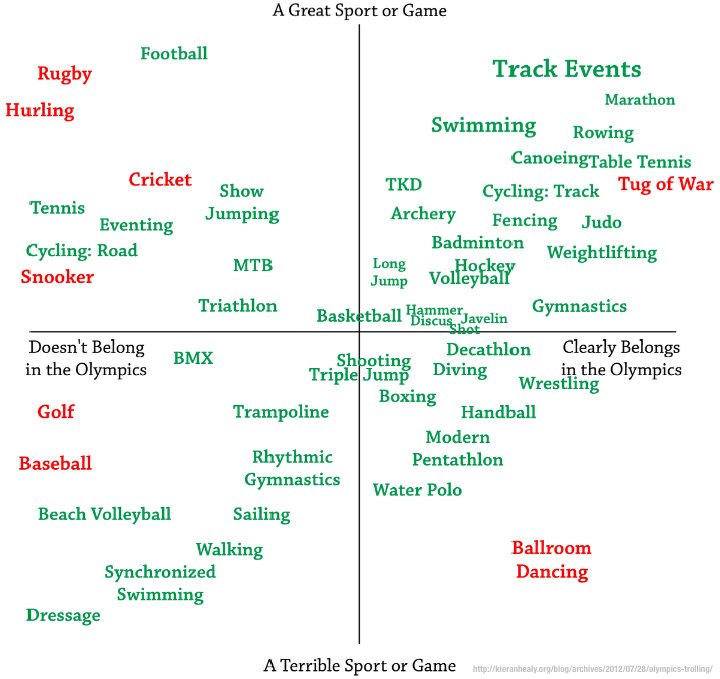
  • But it’s also the time when I’m reminded of my existing personal prejudices about sports, when I may discover new ones (as new events are added), and when I try to figure out whether there’s any defensible rationale to my preferences. Reflecting on my sports bigotry, I think the simplest model is a two-dimensional space that, I think you will agree, is both easy to understand and wholly objective.

Olympic swimming and The Hunger Games collide, and it is perfection: “Why Nathan Adrian Is Real-Life Finnick Odair.”


"25 Olympic Events I Could Actually Win"
  • 22. Marathon-looking at pictures of Ryan Lochte and Tom Daley and thinking about what a generous God ours truly is.
  • 23. Being offended by the sport of beach volleyball in general.
  • 25. Working out really hard one day, feeling all athletic and whatnot, and being like “DAMN DOES THAT EVER DESERVE A COOKIE.”


Hallelujah. “I Won't Hire People Who Use Poor Grammar. Here's Why.”
  • In blog posts, on Facebook statuses, in e-mails, and on company websites, your words are all you have. They are a projection of you in your physical absence.
  • On the face of it, my zero tolerance approach to grammar errors might seem a little unfair. After all, grammar has nothing to do with job performance, or creativity, or intelligence, right?
  • Wrong. If it takes someone more than 20 years to notice how to properly use "it's," then that's not a learning curve I'm comfortable with. So, even in this hyper-competitive market, I will pass on a great programmer who cannot write.
The title sums it up pretty well: “The Drunk Guy, Kobe Bryant Jr., the Nude Model, and the Other Two Guys Who Won Bronze: Meet the Five Men's High Jump Medalists.”


I hate when announcers talk about athletes (usually female) getting “mean” when what they really should be saying is “competitive.”
  •  “You need to have that cutthroat mentality. Not mean and not, ‘I want to hurt you.’ It’s: ‘I respectfully want to beat you and give you my best game. Crush you, yes. Not your soul. Just you, on the court.” – US beach volleyball player Misty May-Treanor, explaining her competitive approach
I love the song. I love the video. Go dancing man! And I want to go to the beach sooooooo bad!
If you’re interested a bio of the dancing man.
  • People know me because I bought an ipod about a year ago and I didn’t want to wait all week for the dance floor and it started bucketing down and I chucked on a suit, inspired by Charlie Chaplin Dancing in the Rain, and just went and danced in the rain and it was so much fun. Everyone filmed me on their iphones, and I woke up and I was Byron Bay Dancing Man all over YouTube.
The 5 Golden Rules Of Moving” – just in case you need them.
  •  2. Remember to eat. This is directly related to number one. When you don’t eat, you feel hangry. (Hanger = anger spawned by hunger.) Hanger is a horrible emotion. It comes from deep down in you, a bubbling cauldron of stress and caloric deficiency leading to a meltdown of child-actor proportions. You might not even think you’re hungry. Just eat anyway. This isn’t about enjoying the meal. This is straight fuel.
  • 3. If you’re wealthy, hire someone to do all this for you. Because duh.
McKayla is not impressed. 


Weird. Not the findings, but more so the Who are these researchers and shouldn’t they have better things to do??? part. "When placed under stressful situations, men rate larger women as more attractive, new research has shown."

Oh the Brits and their dry humor: The Happiest Olympic Worker 2012. (YouTube)

Odds are I won’t be going to Iceland any time soon…so I will just watch this timelapse in awe instead.


"The White Correspondent’s Burden: We Need to Tell the Africa Story Differently"
  • All I can imagine from these headlines is that Africa—all 54 countries, all 11.7 million square miles of it—must be a very deadly place.
  • But I’ve lived there. It’s not.
  • Congo, like America, is very many things, all at the same time. This should be obvious. Why would a foreign country be any less complex than our own? So why, then, if you’re reading or watching most American news, do you tend to see the same simplified stories over and over again?
Go Coca-Cola. This is a great add.

An excellent disclaimer: [Editor's note: This article is completely offensive to every track cycling fan. We suggest you post two comments and come back in the morning.] It's London Olympics meets 'Jersey Shore': Welcome to the Velodrome.”

“If you love the carnage of a great white as it attacks its bait don't miss this video.” Why yes, thank you I will not miss it! “Great White Jumping in Slow-Mo


Mmmk that is all. Have a great weekend!

Thursday, August 9, 2012

Literary Bite: The Language of Flowers by Vanessa Diffenbaugh


Vanessa Diffenbaugh's first novel, The Language of Flowers, is a bit gimmicky, but at the same time sincere and elegant.

The cover and title makes the book appear super-fluffy, but it actually has a lot of depth and serious themes – the foster care system, homelessness, and single motherhood.

The novel is built around (literally) the language of flowers.  Especially popular in the Victorian era, each type and color of flower was attributed with meanings and sentiments. People then used flowers to symbolically convey messages. For example, pansy = loving thoughts, white carnations = remembrance, yellow rose = infidelity, thistle = misanthropy.

The main character, Victoria, a newly emancipated foster child in San Francisco, is kind of obsessed with flower meanings. She reconciles multiple flower dictionaries (an actual thing!) to make her own, which is included in the back of the book.

The story switches back and forth between misanthropic 9-year-old Victoria living in a foster home and hoping to be adopted by a woman who is teaching her the language of flowers, and 18-year-old Victoria (still misanthropic), semi-homeless and working at a flower shop and falling in love with her former foster mother’s estranged nephew. (Sounds a bit soap opera-y, but it’s really not.)

Victoria is a totally believable and generally likeable main character, though I definitely wanted to shake her multiple times throughout the book. She has major trust issues, and doesn't believe that anyone can love her (totally understandable considering the whole foster care thing, but at the same time, Get over yourself everyone can be lovable!!!)

I always enjoy books that take place in Northern California (my home), since I can exactly picture and feel the vineyard/flower farm/farmer’s market an hour north of San Francisco.

This is a great quick summertime beach/pool reading type of book. Good and interesting, but not difficult.
I say thumbs up! (Green thumbs up?) (Oh dear. I'm sorry, couldn’t resist.)

More reviews from the NYT and Washington Post.

Wednesday, August 8, 2012

Sudan and South Sudan: Running in the Olympics


A version of this post first appeared on Enough Said (my office's blog). I have ever so slightly Eat Run Read-ified it.
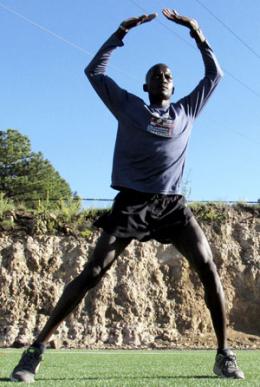
South Sudanese runner Guor Marial.

My work focuses on ending and preventing mass atrocities -- specifically the ones in Sudan, South Sudan, the Democratic Republic of the Congo, and areas affected by the Lord's Resistance Army. Though that line of work may sound bleak (and definitely can be), it's not all doom and gloom. Inspiring news can come out of the conflict areas we follow, especially in an Olympic year.

The Olympic Truce, originally instituted in the 9th century Greek Olympic Games, and adopted by the International Olympic Committee, or IOC, and United Nations in 1992 aims to:
  • Mobilize youth for the promotion of the Olympic ideals;
  • Use sport to establish contacts between communities in conflict; and
  • Offer humanitarian support in countries at war; and more generally: to create a window of opportunities for dialogue and reconciliation.
Despite extensive domestic conflict, athletes from Sudan and South Sudan are competing in the London 2012 Olympic Games.

Olympic Athletes of South Sudan 

South Sudan became the world’s newest country in July 2011. Like all members of the United Nations, it was automatically accepted into the IOC, but South Sudan was unable to organize its own National Olympic Committee, or NOC, in time for London 2012, and therefore cannot send athletes to the games.

Because of this delay, the IOC granted South Sudanese athletes permission to compete under the flag of their former country, Sudan. However, for South Sudanese marathoner Guor Marial, running for the government that is responsible for the deaths of 28 of his family members was an unacceptable option. Marial was granted permission by the IOC to run as an independent athlete under the Olympic flag.

Lopez Lomong, who competes for the U.S.
Marial was forced to flee his home in South Sudan’s Unity state when he was 8 years old and gained refugee status in the U.S. when he was 16 years old. Marial currently lives and trains in Flagstaff, Arizona, and ran his first marathon in 2:12:55 in October 2011. His time bested the Olympic A standard qualifying time of 2:19:00, making him eligible to compete in the Olympic Games.
"I'm running for the refugees,” says Marial, “And I'm running for the South Sudanese, especially."
Possibly the most famous South Sudanese athlete competing in London is Lopez Lomong. This 5,000-meter runner is one of the “Lost Boys of Sudan,” who came to the U.S. in 2001 when he was 16 years old. He is now an American citizen and competes for the United States. Lomong carried the flag for the U.S. Olympic team in the opening ceremonies in Beijing and will compete in the 5,000-meter race on August 8.

Olympic Athletes of Sudan 

Sudan is fielding a team of six athletes at these games: three 800-meter runners, one 400-meter runner, and two 50-meter freestyle swimmers.

In track and field, Ismail Ahmed Ismail ran in the first round of the 800-meters on Monday, August 6, but did not qualify for the semifinals. Ismail, who lives in Khartoum but is originally from the Fur tribe in Darfur, has an impressive Olympic history. He competed in Athens at the age of 19, and in Beijing in 2008 he won silver in the 800-meters, becoming the first Sudanese athlete to ever win a medal.

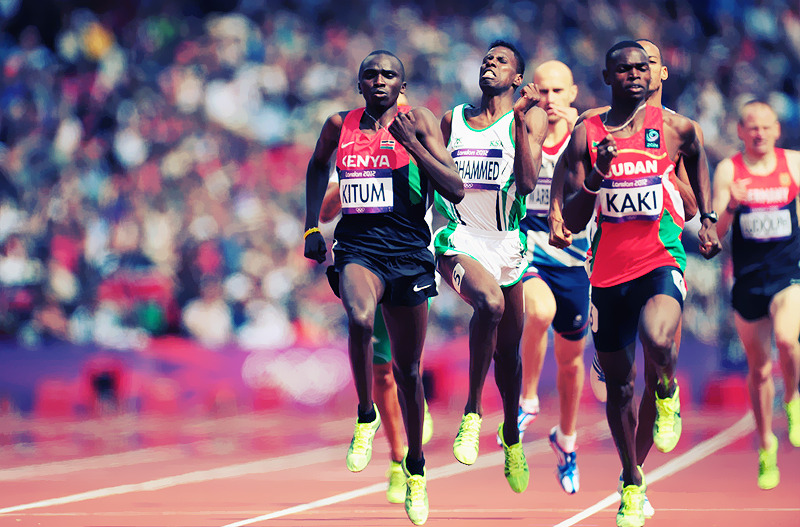
Sudanese 800-meter runner Abubakar Kaki.
It has been reported that on the eve of the opening ceremonies in London, Ismail walked into a police station and requested political asylum. However the Sudanese embassy denied the report and maintained that he will still run the 800-meters for Sudan.

Abubaker Kaki Khamis is another Sudanese 800-meter Olympic veteran. He did not make it to the finals in Beijing but is a two-time World Indoor 800-meter champion and won gold at the 2007 All-Africa Games. In London this year he won his 800-meter heat in Round 1 which advanced him to the semifinals on August 7. In the semifinals he again won his heat, running 1:44.51, and will compete in the finals on August 9.

Rabah Yousif is Sudan’s only 400-meter runner competing in the London Olympics. He comes from a family of Sudanese athletes – his father was a 100- and 200-meter national champion, and two of his uncles were runners and the other a shot-putter. In 2002 while at a training camp in the U.K, Yousif asked for and was granted asylum for 2 ½ years while he was still a minor. Despite his successes in U.K. running, Yousif’s application to gain refugee status was rejected after a 5-year battle, and he returned to Sudan in 2008.

He competed for Sudan in Beijing in 2008, and in London this year he made it to the 400-meter semifinals on August 5 but did not advance to the finals.

Sudan has a one-woman female track and field team: Amina Bakhit will compete in the 800- meters on Wednesday, August 8.

Sudan also has two swimmers, who competed in the 50-meter freestyle in the London Games: one man, Mohamed Elkhedr, who placed 50th out of 58 in the heats, and one woman, 18-year-old Mhasin Fadlalla, who placed 70th out of 73 competitors in the first round of heats last week.

Tuesday, August 7, 2012

Cake of the Week: Cookie Butter Cake with Cashews and Coconut Caramel


I am probably one of the last food bloggers to board to Cookie Butter train, and there is a reason for that. I’ve certainly heard of it. It's taunted me from the shelves of Trader Joe’s and from the recipes popping up on my Reader. But sometimes, with some foods, I just have to say no. That is, until one of my best friends in the whole world requests it for her birthday. Then I say YES.


So let’s talk about Cookie Butter (aka Speculoos, aka Biscoff Spread) for a minute. It tastes like ginger snaps but has the texture of peanut butter. That may sound weird to the uninitiated, but holy Cookie Butter!, I am absolutely never allowed to buy this again. I spend way too much time in a bathing suit for this to be a recurring food product in my life  –  I need to bake it into more things so it stops looking at me every time I open my cabinet.


You may wonder, what do you eat it on? Umm I’m assuming you mean things other than my fingers...a spoon then? No really, Cookie Butter would go well on anything that is good with peanut butter or Nutella. I'm thinking Cookie Butter crepes, Cookie Butter on toast/muffins/bagels. Cookie Butter baked into cookies…or spread on cookies. Seriously, I don’t think the how will be your problem, it will be how to stop.


This Cookie Butter Cake with Cashews and Coconut Caramel has a lot of things going on, but since it’s only one layer, it doesn’t actually seem that intense (see what I did there? rationalization = one of my many talents.) If you so choose, I think you could even skip the caramel part and just go for the cake with frosting. OH MAN the frosting!!!

Cookie Butter Cake with Cashews and Coconut Caramel

Recipe from Sugar Plum.
Printable recipe. 
Cake Ingredients:
  • 3 tablespoons unsalted butter, softened
  • 3 tablespoons Cookie Butter or Biscoff Spread
  • 1/2 cup granulated sugar
  • 1 large egg
  • 1 teaspoon vanilla extract
  • 1 1/2 teaspoons baking powder
  • 1/2 teaspoon baking soda
  • 1/4 teaspoon salt
  • 1 1/2 cups all-purpose flour
  • 3/4 cup coconut milk
  • 1/2 cup finely chopped toasted cashews
  • 1/2 cup sweetened flaked coconut
Caramel Ingredients:
Note: This caramel recipe makes about twice as much as you need...tupperware the extra caramel and make another cake later!
  • 1 cup coconut milk, divided use
  • 1/3 cup brown sugar
  • 2 tablespoons corn syrup
  • 2 tablespoons butter
  • 1/8 teaspoon finely ground sea salt 
Frosting Ingredients:
  • 2 tablespoons unsalted butter, softened
  • 2 tablespoons Cookie Butter or Biscoff Spread
  • 1 cup confectioners' sugar
  • 1 tablespoon milk
  • 1/2 teaspoon vanilla extract
Directions: 
  1. Preheat oven to 350 degrees F.  Spray and flour a 9-inch round cake pan. 
  2. In a large mixing bowl, beat  butter, cookie butter and sugar until creamy - about 1 minute.  
  3. Add in the egg, vanilla, baking powder, baking soda and salt, and beat until well combined.  
  4. Alternate adding in flour and coconut milk (flour, coconut, flour, coconut, flour), and mix until just combined. Finally, mix in cashews and coconut. 
  5. Pour batter into prepared pan and bake for 25 minutes, or until golden brown and cake begins to pull away from the sides of the pan.  Cool 10 minutes in the pan before running a knife around outside edges and turning onto a wire rack to finish cooling.

To make the caramel sauce:
  1. Bring to a boil over medium heat: 1/2 cup coconut milk, brown sugar and corn syrup in a medium saucepan.
  2. Boil, without stirring, until caramel reaches 236 degrees (soft ball stage).  
  3. Remove pan from heat and whisk in remaining coconut milk, butter and sea salt.  
  4. Using a fork, poke a generous amount of holes into the top of the cake, and pour caramel on top.  
To make the frosting:
  1. Beat all the ingredients together until smooth. Add more milk or sugar as necessary to reach a spreadable consistency.  

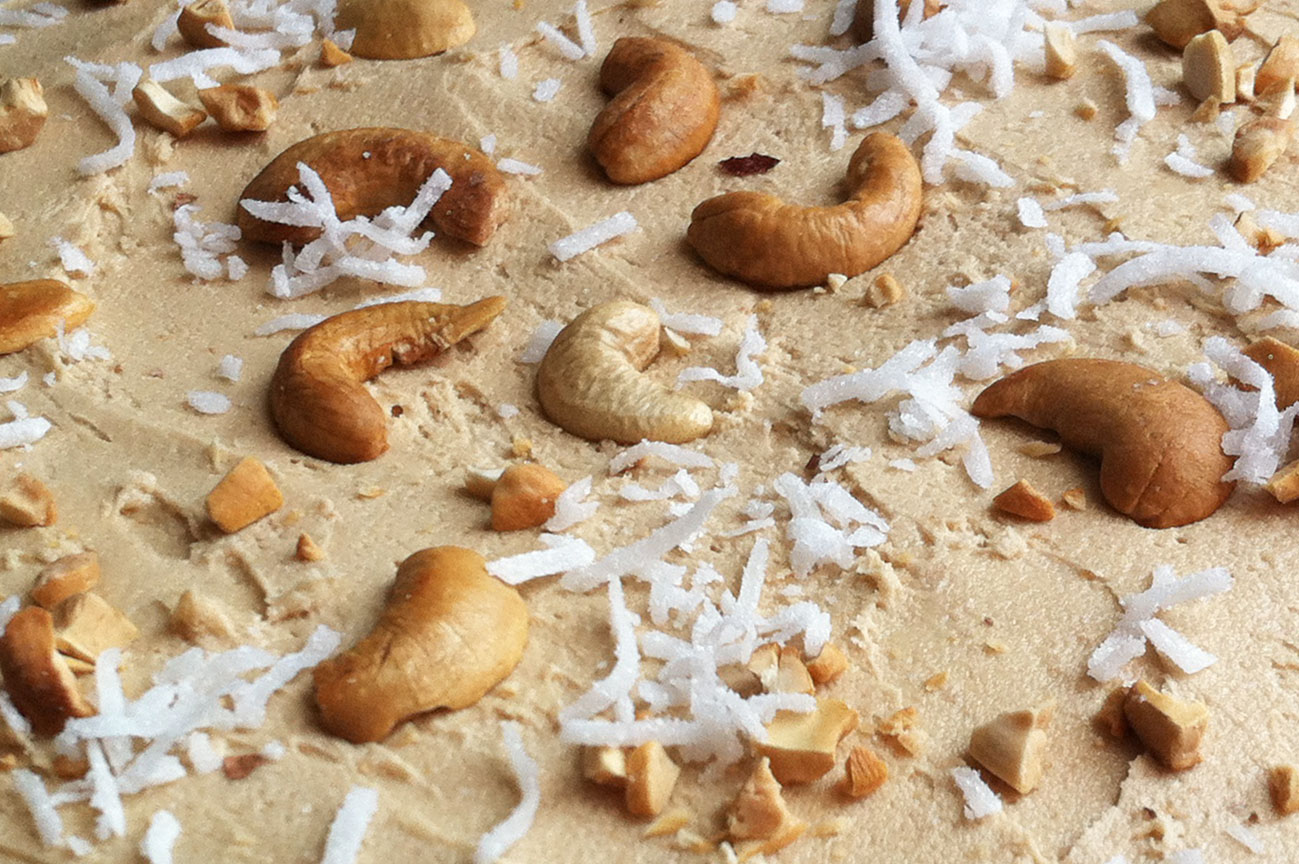
Frost the cake, decorate with coconut and cashews, transport to your friend’s house, cover in candles, sing Happy Birthday, and enjoy!

Printable recipe. 

Monday, August 6, 2012

Weekend Report: Watching Soccer and Olympics


I love when people get excited about things they really really care about. Everything is the most fun for everyone when people get into what they’re doing or watching! (Superlative count in that sentence: 3, and I’m not ashamed.)


For example, on Saturday night, SpeedyKate, LOTR-Emily, her BF, and I went to a DC United soccer game. All of us like soccer, have played it at some point, and enjoy watching it; however, compared to the super-fans in front of us, we were just casual bystanders. But because they were so excited – literally shaking the stands, chanting, flag-waving, and throwing $10 beverages in the air when United scored – we got pretty amped up too. DC United beat Columbus Crew 1-0, and it was a  really fun Saturday night!


The soccer game was an example of others’ excitement affecting me…but Olympic Track and Field, well now that’s a thing that I get ridiculously excited about. All the swimming/gymnastics/etc. over the first week of the Games has been good warm-up, but now the real Olympics (for me) have started and it is important that I see it all.

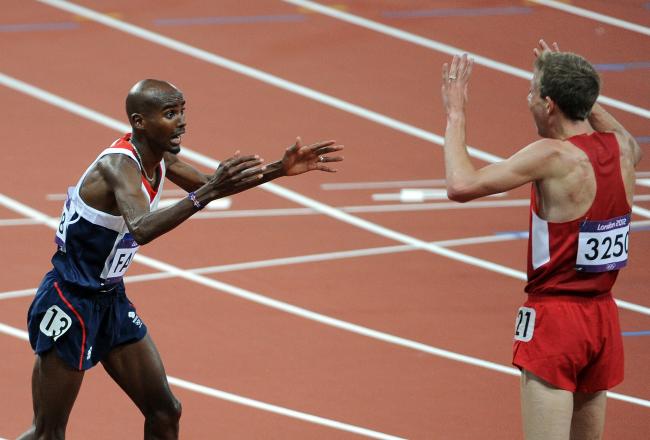
Did you watch the Men’s 10k on Saturday afternoon? The moment when Mo Farah (UK) won the race, turned, and realized that his training partner Galen Rupp (USA) got the silver was hands-down my favorite Olympic moment to date. SpeedyKate and I were literally screaming at our TV for the last 800m of that race.


Is excitement compoundable? Because if it is, then the running enthusiasm increased exponentially for the Women’s Marathon on Sunday. One of our former CAR teammates, Claire Hallissey, ran the marathon for the UK, so a group of CAR-ers convened to cheer for her en masse.


I’m always happy to spread the sports-love and explain running/sports/Olympics to any friend or co-worker who asks, but there’s something super-awesome about watching a marathon in a room full of legit marathoners. Everyone knows what they’re talking about and can connect to the experience – it was fun.

I took that London marathon inspiration and went for my own rainy-day run on Sunday night. It definitely wasn’t 26.2 miles, but 10.4 is pretty marathon-ish for me at this point and running in the rain is glorious!

Friday, August 3, 2012

Best of the Week #70


I love running and believe it is a totally reasonable thing to do every day. So too is going out, having fun, and being social. The tricky part is when you try to do both all the time. I’ve gotten pretty good at the running/social life balance, but every so often (ahem, or too often), I try to fit in too much and it just becomes too much.

This week was a pretty extreme case. (All of my activities sandwich a standard 8/9-hour work day, obviously.)  It went like this:
  • Monday morning – run.
  • Monday night – SpeedyKate packed a picnic and LOTR-Emily joined us to see From Here to Eternity at Screen on the Green on the National Mall.
  • Tuesday morning – track workout.
  • Tuesday night – 6x6’s birthday celebration.
  • Wednesday morning – run.
  • Wednesday night – rock climbing 
  • Thursday morning – sleep (day off!)
  • Thursday night – a very late-night dinner with my co-workers (we joined my Darfuri co-worker in fasting for the day and then went to break the fast at a Middle Eastern restaurant in VA. 
  • Friday morning – sleepy-pants. 
But all of the things I do are things I want to do, so whatever, I’m tired, I’ll sleep this weekend.

ANYWHO. Let’s talk Best of the Week. It’s been all-Olympics-all-the-time, with a few brief other things, so bear with me here.

Oh but first – MEDIA ALERT – the women’s 10K is today at 4:30 EST. You can watch it online and on NBC. Doooooo it.

Looks like me being behind the curve (technology-wise) is actually me being ahead of the curve in this case! “How to avoid Olympics spoilers.” 
  • 3. Your smartphone is your enemy during these next two weeks. If you carry it around, you will be tempted to check the Internet, and you risk receiving spoiler-laden text messages from your gymnastics-loving friends. Switch to an older phone for the duration of the Olympics, preferably one that is decades old, is shaped like a brick and has a wan green display that can handle neither text messages nor the Internet.
This article from Smithsonian Magazine, "Spanx on Steroids: How Speedo Created the New Record-Breaking Swimsuit" is fascinating

  • At Aqualab, researchers took four years and spent 55,000 man-hours to produce what Speedo calls the Fastskin 3 system…They called on experts in kinesiology, biomechanics, fluid dynamics and even a sports psychologist, who suggested a blue-gray tinge on goggle lenses to instill a sense of calm and focus. They tried the “Six Thinking Hats” method of brainstorming, a green hat for creative ways to attack a problem, a black one to look at the feasibility of those ideas. They “reverse brainstormed,” picturing how to make a swimmer go as slow as possible with oversized goggles and a suit compressing the body so parts stuck out, creating drag. The crazier the idea, the better.
  • In the end, Fastskin is Spanx on steroids, compressing a body three times more than the LZR. The suit constricts the stomach the least and the chest, buttocks and hips the most, attempting to mold swimmers into an unblemished tube.
  • Just wearing the Fastskin requires athleticism. Some female swimmers, who step into the suit through an armhole, reported it took them as much as an hour to wriggle into it on their first attempt. Santry says it can be done in 10 to 15 minutes with practice. “The first time you do it, it’s daunting,” he adds. “There’s quite a bit of compression in the suit. It can feel a bit alien.”
From Hilarity in Shoes (non-Olympics related): “Ten Thing Thursday: Best I Can Do Edition.” It’s all funny, but boys should note #3.
  • Unknown woman: (Breaks well-known rule of acting deaf and blind in elevators. Clutches K’s arm with a wild look in her eye.) I really, really hope you just changed that man’s life.
Fasting during the Olympics has got to be hard. “Olympics: Ramadan proves challenging for Muslims.”
  • Mohamed Sbihi, Britain's first Muslim rower, is taking a different approach. A practicing Muslim, Sbihi has elected to buy 1,800 meals for Moroccan street children in place of risking his own Olympic dream, as well as those of the seven other men in his boat. "It is written in the Quran that those who are unable to fast either have to feed 60 people or fast for 30 days for every day that they miss intentionally," Sbihi told the Daily Mail, "That worked out at 1,800 people or five years of fasting."
Petaluma (i.e. my hometown) looks so good in this article


Enter in your height and weight to find“Your Olympic athlete body match.” Turns out I’m most like Francesco D. Aniello, a 43-year-old Italian male shooter…welp that sucks…


2012 London Olympics: Don’t blink or you’ll miss the speeding objects.” Ummm a table tennis smash is 70 mph?!?!
  • Besides the swiftness of the athletes themselves, the Olympics showcase the speeds at which they can throw, kick, and propel a variety of balls and objects. While little information is available on some of these speeds, here are the best approximations of how fast things may be traveling at the London Games.
I strongly believe that 80% of running “injuries” can be solved with a foam roller. (See the full infographic bigger.)

I keep telling people about this article, so you should probably read it: "Which Records Get Shattered?"

  • Another factor: an athlete with the perfect swimmer’s build and a world-class work ethic would still stand little chance of competing in this year’s games if he happened to be born in a poor nation like Cameroon or Panama — he might never have gotten into a pool, let alone an Olympic-size one. But running, especially over short distances, can be practiced virtually anywhere and anytime.
  • Which leads to this: As Stephen Jay Gould noted, the more open to competition a sport is, the harder it may be to break records or to post extraordinary statistics. 
  • In the track and field events, it is more likely that an athlete has already come close to what Gould called the “right wall” of human performance, simply because the human being who possessed the ideal build and work ethic is more likely actually to have competed in the Olympic Games.
I realize I write a running blog, but I really really try to avoid this sort of thing: “I'm Truly Sorry For This, But You're About To Hear All About The Last Marathon I Ran.” 
  • Worst of all, though, I'm definitely going to run other marathons in the future, so I'll have to tell you all about the various races I'm thinking about entering and the pros and cons of each course. Please, accept my deepest apologies in advance, because as excruciating as today's discussion is, it won't end here. Every single day during my weeks of preparation leading up to the next race, I'm going to make you stop whatever you're doing to tell you the number of miles I ran the previous evening. Isn't that awful? No one should have to listen to that.
The New Yorker on "Doping and Running." 

  • The limiting factor in distance running is injuries, and the greatest challenge in the sport is finding a way to make the hundred and twenty miles a week manageable.
  • Culturally, the race I’m most interested in is the eight-hundred-metre… it’s the only one where there seems always to be genuine diversity. Americans are good at it; so are Europeans, and so are Africans. The top five runners of all time in the race are from five different countries. The top ten come from eight different countries.
Regarding the South Sudanese runner -- a summary of a legal debate: “Can There Be a “Global Solution” to Strategic Olympic Nationality?
  • Shachar and Chappelet, on the other hand, see abuse in the current regime. No doubt there are “strange nationalities.” In some cases, individuals have exploited an anomalous basis for citizenship in countries to which they have little or no affective (or effective) attachment – often on the basis of a parent or grandparent’s nationality. In others, countries have in effect bought competitors, with a grant of citizenship as a necessary part of the bargain.
On the non-Olympics serious side: "Stopping Mali from Becoming Somalia."
  • If there is any lesson to be learned from two decades of crisis and conflict in Somalia, however, it is that inattention and inaction by the international community fuels instability and enables conflict to spread beyond borders. Thus, as the international community deliberates over how and when to restore order and governance in Mali -- hopefully, sooner rather than later -- it is clear that NATO can, and has a certain obligation, to play a supportive role to the ECOWAS force.
  • Another painful lesson from Somalia is that there needs to be a legitimate government to consolidate the security gains that any U.N. or AU-authorized force might make. Malians are the ones ultimately responsible for restoring a credible government -- but the country's Western partners would be well served to invest as much, if not more, in governance, civil society, and job creation than in counterinsurgency in order to achieve that outcome.
Oof a lot of words in this post...sorry but I'm not sorry? They're all so good! To leave you with something funny (or at least I think it's funny): this picture from 1972...the one with the mustache and white shorts may or may not be mi padre...


Have a great weekend! The Women's Marathon is on Sunday -- GO USA! And GO CLAIRE!!!

Thursday, August 2, 2012

Baked Beet Chips with Greek Yogurt Pesto Dip


Kitchen gadgets take up so much space. I’m pretty sure everyone has that bottomless drawer of randomness (lemon juicers, spatulas, assorted measuring cups and spoons, cookie cutters, peelers, zesters, etc.), plus a decent amount of cabinet and top-of-the-fridge real estate dedicated to blenders, mixers, juicers, or whatever. I try to keep my gadgets to a minimum (oh apartment living)…but let’s be real – things accumulate and some cooking tools are super-handy!


Case in point: my mandoline is my favorite kitchen gadget.  (I’m talking about a mandoline slicer, not a mandolin musical instrument...see the video at the bottom of this post to learn how to use one.)

The glory of my mandoline is that it allows me to slice thinly and evenly (julienne if we’re getting technical and fancy). It also has attachments to make crinkle-cuts and waffle cuts, though I may or may not have lost those blades…whoops!


Luckily the standard blade does the most important thing – easily slice vegetables into chip-making thickness. I recently experimented with Baked Beet Chips and they were soooooo easy and delicious. They definitely taste like beets (kind of earthy and a little sweet), but the flavor is not over-powering. And they go very well with this tangy garlic-y yogurt dip. (The chips are fragile, so a heavier or more dense/chunky dip would probably just break them.)

Baked Beet Chips with Pesto Greek Yogurt Dip

Printable recipe.
Ingredients:
  • 3 large beets 
  • 1 tablespoon olive oil
  • Salt and pepper
  • 1 cup plain Greek yogurt (non-fat or regular)
  • ¼ cup pesto (see my Walnut Pesto recipe)
Directions:
  1. Toss beets with olive oil, salt, and pepper.
  2. Thinly slice beets with a mandoline (you could also do this with a sharp knife, it’s just a lot more difficult to get them thin enough).
  3. Spread evenly on a baking sheet. (It may look like you have a ton of chips in production, but as they bake they shrink down a lot.)
  4. Bake 15 minutes, then flip them all over. Bake another 10 minutes or until chips are crisp. Serve or cool completely and store in a sealed container. 
  5. Mix yogurt and pesto to serve with beet chips.
  6. Enjoy!
Printable recipe.

How to Use a Mandoline:


Wednesday, August 1, 2012

Back to the Track!


It’s been a while, but after my impromptu race last week I decided that yes, I’m ready, it’s time to start track workouts again.

I had evening plans last night (HAPPY BIRTHDAY 6x6!!!), which meant that yesterday morning my 5:05 alarm sounded – time to get up for a CAR workout! (Morning workouts start at 6:30 and warming up starts at 6:15, but the track is a long metro ride away from my apartment.)


Some people love the endurance challenge running mileage, others love the competition and test of racing, but I like the fusion of those factors – basically, I love workouts. When done right, they’re hard but not excruciating; long but not boring; and teammates push each other but do not race. Plus, if all things go according to plan, workouts get better and better and serve as a weekly reminder that your efforts are paying off.

This is a good getting-back-into-things workout: 2 x Mile + 2 x 800.

We were all kind of getting back into things this week. My teammates have been doing hill repeats (instead of track work) all summer, and I have only been running mileage. Plus this was my first workout in a while, so I had no real expectations: Run. Feel good doing it. Don’t hurt myself. Fin.

Anyone can (and should?) try this workout, even if you don’t have a track full of excellent runners to pull you along! Miles and half-miles are an easy distance to map out on trails or in your neighborhood. Plus, since the repeats are on the longer side, there’s no need to run crazy-fast…maybe go for 5k pace for the miles? And then the 800s should be a bit faster. Consult Coach George’s pace chart here to find out the times you should run based on your race paces.

The Workout: Miles and 800s

Total distance: about 8 miles
  • Warm up: Jog 15 minutes
  • Drills and strides (watch a video of how to do them)
  • 1600m (1 mile), jog 800m recovery
  • 1600m (1 mile), jog 800m recovery
  • 800m (1/2 mile), jog 400m recovery
  • 800m (1/2 mile)
  • Cool down: Jog 15 minutes
Some wise works from Coach George: We include the interval sessions in our marathon training as a change of pace, and as a way to improve everyone's running efficiency, but we don't want to turn them into high intensity, crushing anaerobic sessions. You don't want to leave yourself so beaten up after the interval workouts that you need to back down on your training volume on the days following the workouts in order to recover.

I recovered fine (and am not a marathoner anyways), so hooray for track workouts!!!

And for those who care (i.e. my dad), I started slow and finished fast: 6:32, 6:12, 2:51, 2:52.